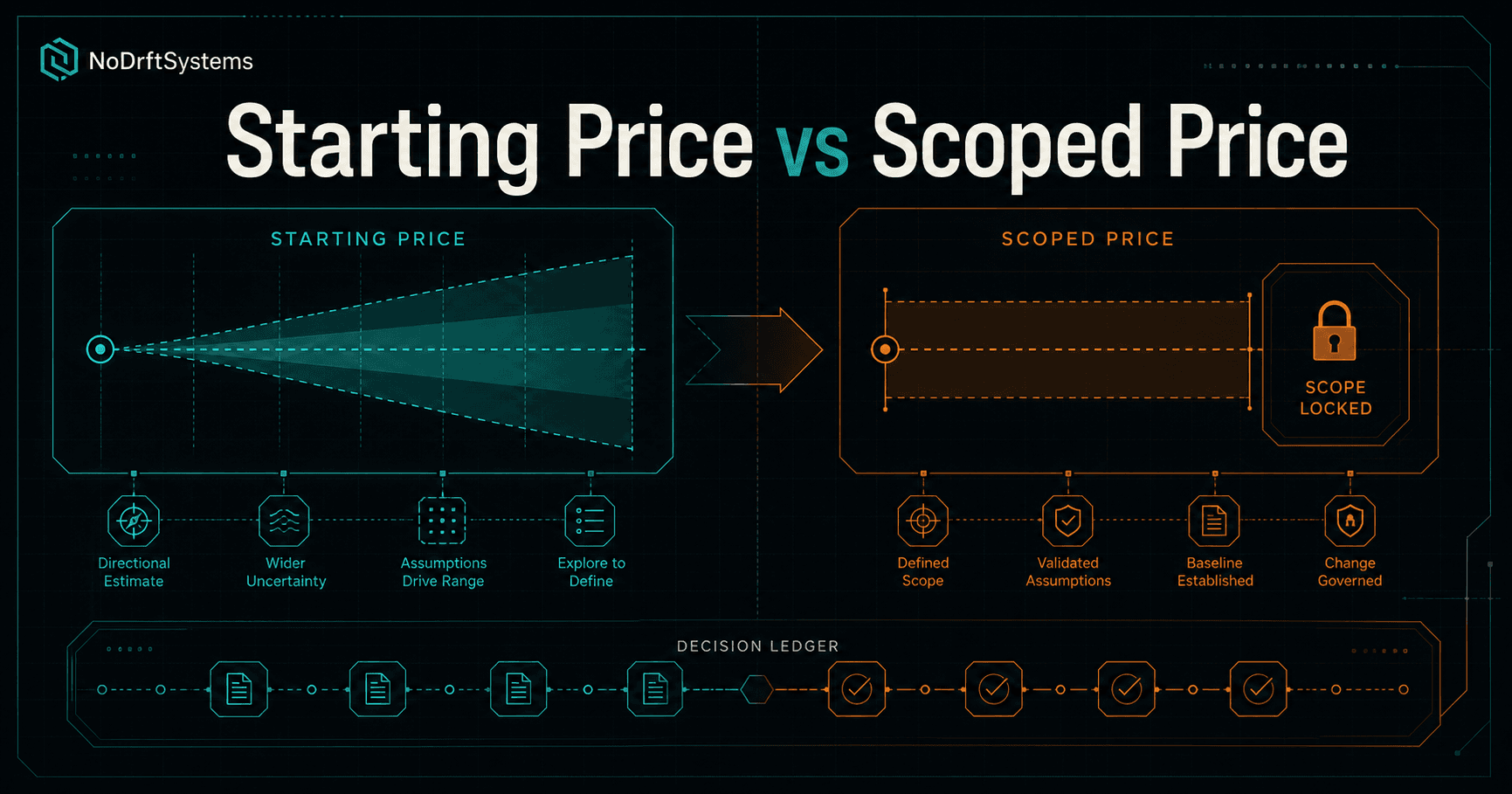
Why a floor price is published at all
A starting price serves one function: it tells a prospective client whether their budget and the category of work they need are in the same range before either party spends time in a discovery conversation. It is a constraint on the conversation, not a quotation. Publishing it is an act of respect for the buyer's time — and for the firm's. The alternative is a process where pricing only becomes visible after hours of discovery, at which point walking away is more disruptive for both sides than it would have been at the beginning.
What moves the scoped price above the floor
Four variables reliably move a scoped price above the starting floor. Content complexity is the most common: the floor assumes the client delivers final content. When copy, photography, or strategy must be created as part of the engagement, that work carries its own scope and price. Integration requirements add another layer: a build that must connect to an existing CRM, booking system, or payment processor requires scoping and build work that no base package includes. Bilingual delivery means two coordinated surfaces held to a parity standard — not translation, transcreation. And timeline compression, when real, has a price: emergency delivery limits parallel execution, and that constraint is reflected in scope.
Where the BA Sprint fits in this math
The Business Analysis Sprint (BA Sprint) is the instrument that converts a starting price into a defensible scoped price. Without it, the alternatives are a fixed bid based on incomplete information, or a time-and-materials engagement with no cost ceiling at signing. Neither is a good deal for either party on a build above the simplest tier. The sprint produces a documented brief with defined deliverables, known content requirements, identified integrations, and a confirmed timeline. The sprint fee is credited toward the build engagement if the client proceeds within 30 days — a structural recognition that discovery is a phase of the build, not a cost imposed before it.
The one price anchor we publish publicly
The advisory rate — $95–$175 per hour — is the one public price anchor NoDrftSystems publishes. It applies to engagements where the client needs structured thinking and documentation rather than production output: strategy sessions, architecture reviews, audit work, second opinions on existing builds. We publish it because it is the most transparent expression of how expertise is valued before a build begins. Clients who engage at the advisory rate before a project have a better-defined brief when the build starts — because they have spent structured time building it. That investment consistently shortens the scope phase and reduces the probability of mid-engagement course corrections.