Two different questions
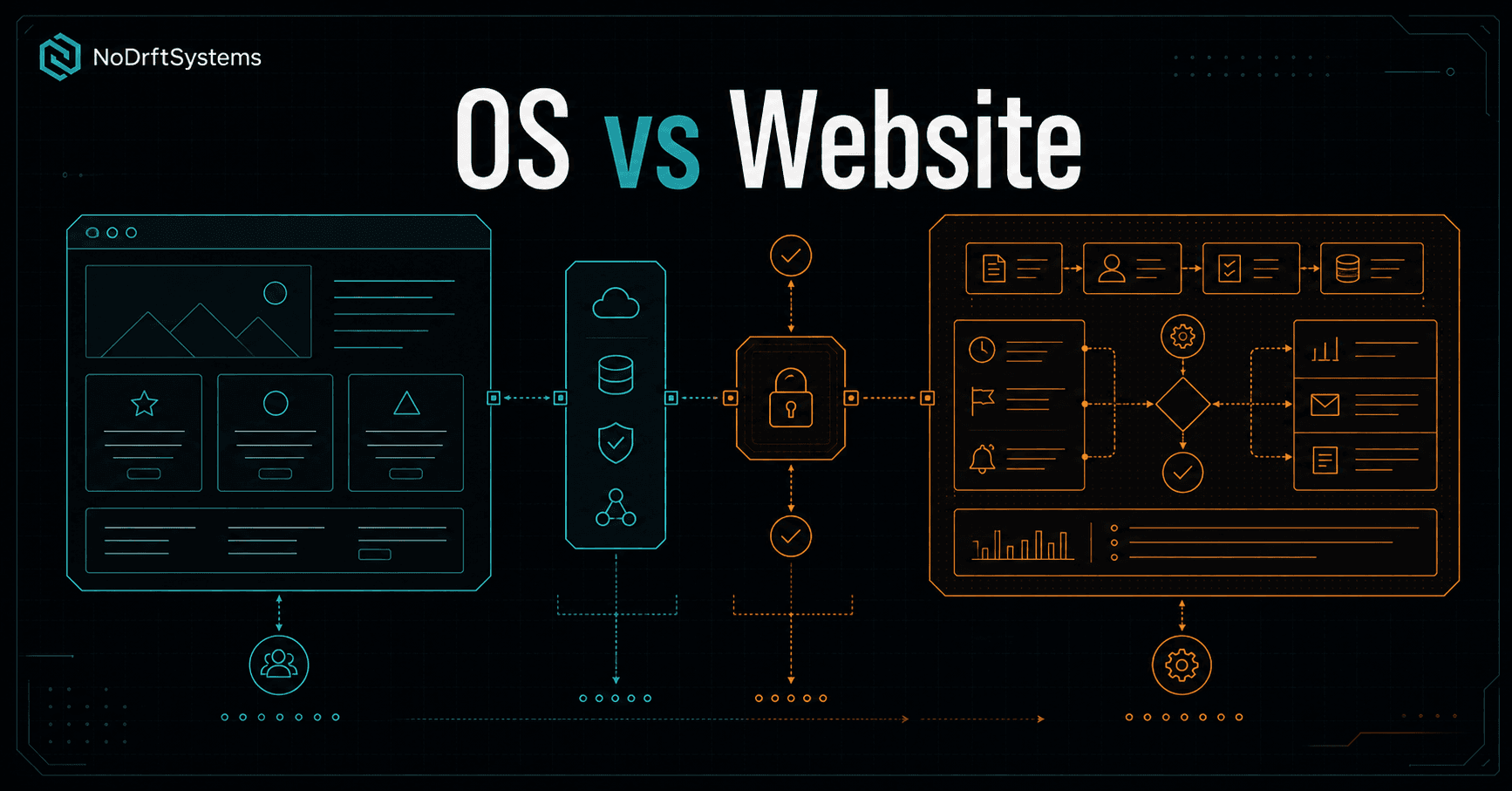
A website answers one question: how do people find, evaluate, and contact us? A Management Operating System answers a different question entirely: how does this business actually run? These are not the same question, and the investment that answers one does not answer the other. The confusion between them is expensive because it is usually resolved by buying the surface — the website — and then wondering why the underlying operation did not improve. The pharmacy still tracks inventory in spreadsheets. The restaurant still takes reservations by phone. The retail chain still reconciles POS data manually at month-end. The website launched and looked correct. Nothing operational changed.
What a Management Operating System actually does
A Management Operating System (MOS) is the software layer that governs how a business's core operations are planned, executed, tracked, and reported. It is distinct from a website, a CRM, and a general-purpose spreadsheet — all of which store or display information but do not manage workflows with rule enforcement, role-based access, and audit trails. A POS OS captures every transaction, applies pricing rules, routes to inventory management, and generates reports at defined intervals. An HR OS manages employee records, schedules, attendance, and timecard data within a single governed system. A Pharmacy OS manages dispensing, regulatory compliance, inventory, and patient records as an integrated workflow — not a collection of disconnected tools.
Reading the signals: which does your business actually need?
The signals that indicate an OS need versus a website need are behavioral. A business that struggles to find customers, articulate its value, or convert inquiries needs a website. A business that struggles to fulfill orders consistently, maintain inventory accuracy, reconcile payroll correctly, or report on operations with confidence needs an OS. Many businesses need both — but not always in the order they assume. A pharmacy with broken dispensing workflows but no online presence needs the OS first. A management consultancy with excellent internal operations but no coherent market-facing identity needs the website first. Getting this sequence right determines whether the investment compounds or cancels itself.
The upgrade path — and why it matters from the first build
NoDrftSystems structures its product portfolio around a specific maturity path: credibility first (website), then operational discipline (OS), then scale (integration and reporting layer). A client who starts with a website build can, at the right point in their business development, add an OS layer on top of the commercial foundation already in place. The OS does not replace the website. It extends the infrastructure underneath it. Clients who understand this path from the first conversation make better initial build decisions — because they scope the website with the eventual OS integration in mind, rather than discovering eighteen months later that the surface they built is incompatible with the engine they need.