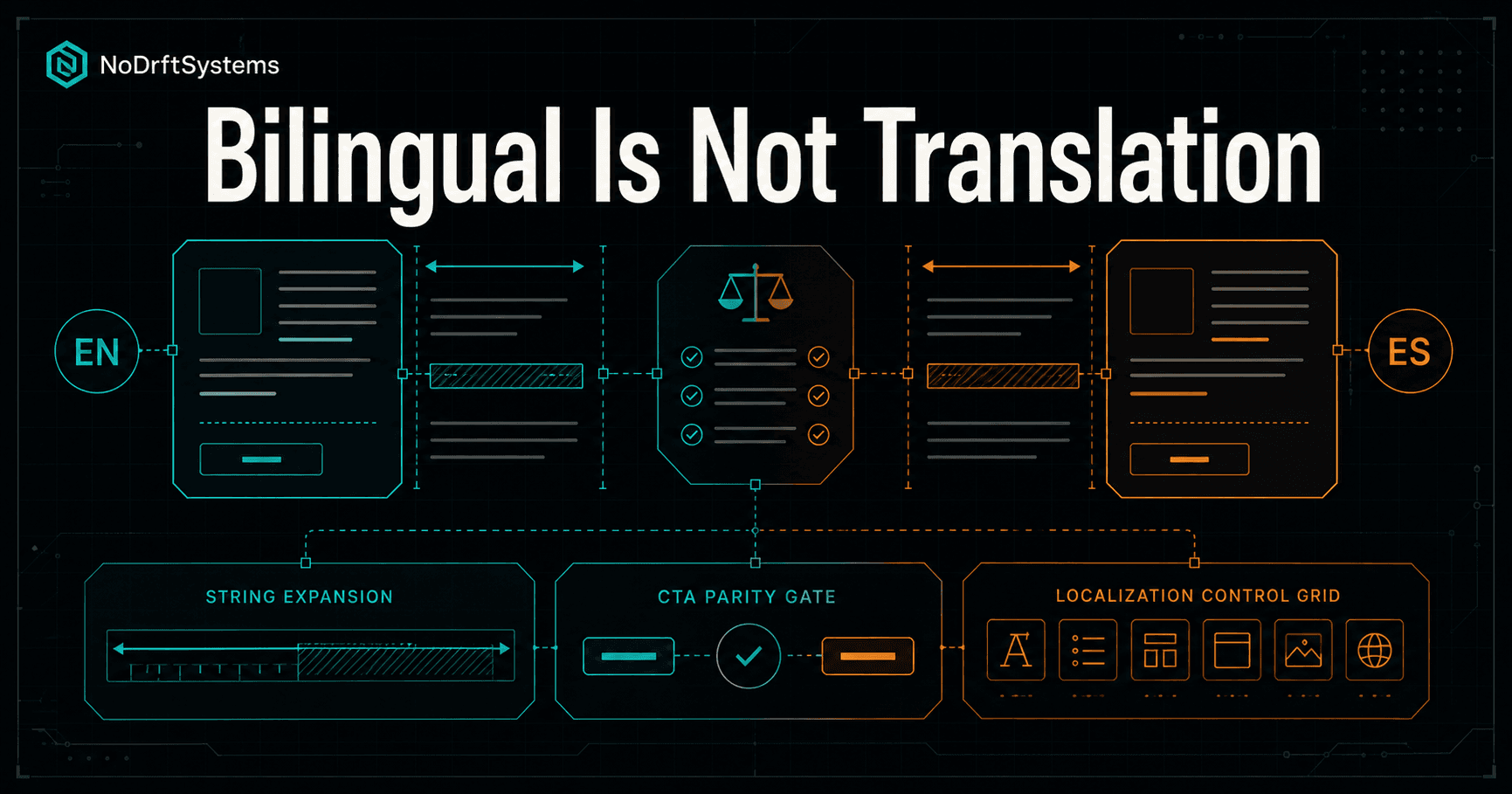
What breaks visually when you translate without designing for it
Spanish text is, on average, 15–25% longer than its English equivalent. This is not a minor variation — it is a structural fact that every bilingual site must be designed around, not patched after translation. A navigation bar that reads cleanly in English at five items overflows in Spanish at the same font size. A button that fits a two-word English CTA requires three words in Spanish, breaking the button's visual balance. A headline set in two lines in English wraps to three lines in Spanish, pushing content below the fold. These are not typography problems. They are layout architecture problems, and they must be solved at the design phase. Sites that treat translation as a final step discover these problems after the build is complete — at which point fixing them means rebuilding, not patching.
What breaks commercially when the register is wrong
Layout problems are visible. Register problems are invisible until they damage trust with a Spanish-speaking user. English marketing copy frequently uses imperative constructions that map cleanly to Spanish in form — but carry a different commercial weight. Spanish imperatives in formal commercial contexts have a directness that English counterparts do not. They can read as presumptuous or overly transactional depending on the relationship, the industry, and the regional market. A Colombian business audience has different register expectations than a Jamaican Spanish-speaking audience. Neither is wrong — but serving the wrong register to either is a commercial mistake that translates directly to lower conversion and eroded trust.
Why CTA copy is the highest-stakes bilingual decision
Call-to-action text sits at the conversion point of a commercial site — it is the moment a visitor decides to move or not. English CTAs that are short, direct, and action-oriented are commercially correct in their cultural context. Spanish CTAs that directly translate those constructions are formally correct and commercially weak in markets where the buyer-vendor relationship is expected to be warmer and more collaborative. A Spanish-speaking buyer reading a transactional CTA may feel directed rather than invited. In markets like Colombia and Jamaica, trust is a commercial variable — not a soft preference. A CTA that signals low trust does not just fail to convert. It actively signals that the brand does not understand its audience.
What transcreation costs and what it buys
Transcreation is priced differently from translation because it is a different service. Translation converts meaning from one language to another. Transcreation re-creates the communicative intent — the emotional register, the commercial effect, the cultural signal — in the target language. For a bilingual site, transcreation typically runs at 40–60% of the copywriting cost for the English version, depending on content density and the volume of conversion-critical copy. This is not an optional enhancement. It is the cost of building a Spanish-language commercial experience that performs. The alternative — literal translation — is cheaper to produce and consistently less effective to operate. The difference compounds over the lifetime of the site in the form of lower conversion rates, higher bounce rates from Spanish-speaking visitors, and a brand signal that says: we translated for you, but we did not think for you.