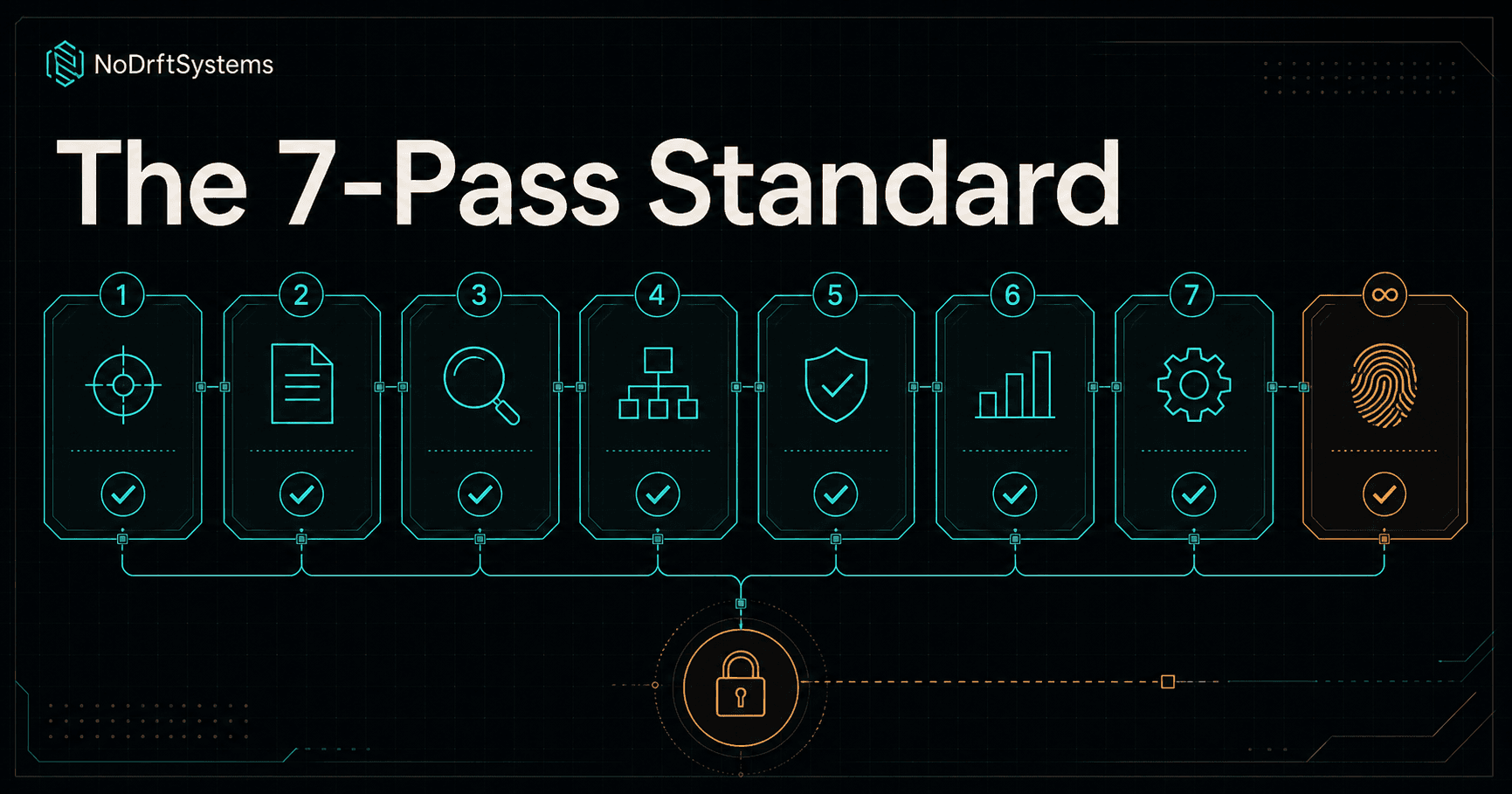
The problem with confidence at launch
The moment a team is most confident a product is ready is usually the moment they are most exposed. The brief is known by heart. The build is familiar. The final test environment feels like home. Confidence, in this context, is a liability — because it is confidence built on familiarity, not verification. Layered verification exists for exactly this reason: familiarity and accuracy are not the same thing.
Eight categories of failure — and why a single review cannot catch them all
A build fails in distinct ways: functionality failures, content errors, visual defects, security exposures, scope gaps, accessibility violations, error-state omissions, and competitive indistinction. These categories do not fail together — they fail independently, at different stages, and under different review conditions. A functional review catches what does not work as specified. A content review catches placeholder text, brand voice drift, and unverified claims. A technical review catches security vulnerabilities and performance defects — no high-severity vulnerability proceeds to the next stage. A scope review confirms that every deliverable named in the signed agreement is present and complete.
Accessibility review — WCAG 2.1 AA compliance, keyboard navigation, screen reader support — is not optional on any public-facing build. Error-state review confirms that every known failure path has a handled response: a branded error page, not a raw framework screen. Bilingual review, where applicable, verifies that English and Spanish versions hold equivalent meaning, tone, and conversion strength — not just grammatical accuracy. These are not supplementary checks. Each addresses a category of failure that a functional review cannot see — and the sequence is the point, because these categories do not surface under the same conditions.
The differentiation check — the one most teams skip
The final check in the sequence asks one question no automated tool can answer: does this work look, read, and function differently from the category default? It requires a documented comparison against at least three category norms and demands three observable, specific differences — not different in principle, but different in practice, on screen, in the hands of a user. A deliverable that cannot demonstrate those differences does not clear this check. This is the check most teams skip because it requires judgment, not tooling. It is also the check that separates a delivered product from a differentiated one — and that distinction determines whether a build stands apart from the category or disappears into it.
Why skipping any review always costs more than running it
The pressure to skip comes at the end of every engagement, when time is short and the team is ready to move on. The argument is always the same: we know the work, we've checked the main cases, we can ship and patch. The problem with that argument is that post-launch defects cost significantly more to fix than pre-launch defects — in development time, in client trust, and in the compounding reputational effect of a product that ships with visible problems. No review category has optional status. An authorized deviation from the sequence must be documented, scoped to the specific deliverable, and approved before release. It does not carry forward to future engagements.